Church Blog
News, Updates, Thoughts
The latest news, updates, and thoughts from Walbury Beacon Benefice.
Dear Friends
Dear Friends
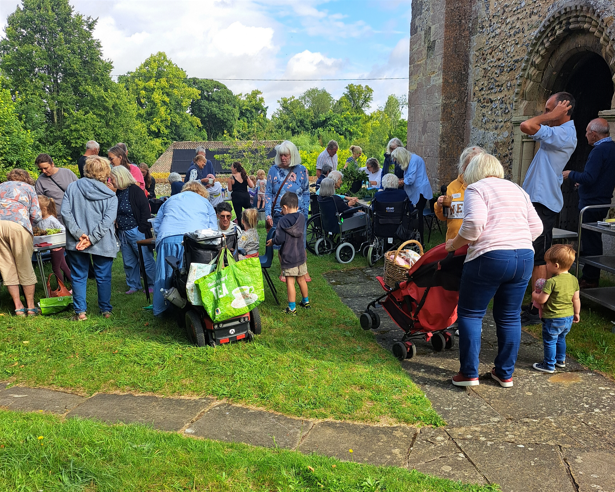
I am delighted to share the success of our recent wild church event, a morning filled with creativity, learning, and fellowship that brought our community closer together in both spirit and purpose. This gathering was a beautiful testament to what can happen when we step outside the traditional church walls and engage with God’s creation in meaningful and joyful ways.
Our wild church activities were designed to connect us with nature and with each other, as we celebrated the beauty of God's world. The morning was filled with hands-on activities that everyone, from the youngest children to the oldest members of our community, could enjoy. We made bird feeders, bee and butterfly feeders, arranged flowers, and even created recycled elephants as a reminder of the importance of sustainability and caring for God’s creatures. The seed bombs we crafted will bring new life to the earth, and the bug hotels provide safe havens for insects, reminding us of our responsibility to protect the smallest of God’s creations. The smiles on the children's faces as they had their faces painted and the wonder in their eyes as they learned about bees from a local beekeeper highlighted the joy that comes from discovery and learning.
What made this day truly special was the spirit of community and inclusiveness that permeated the event. We were overjoyed to be joined by residents from Notrees, who were wheeled down by the Community Volunteers. Their presence was a blessing to us all, reminding us that the church is not just a place, but a people—a family that extends love and care to everyone, regardless of age or ability. The sight of different generations coming together, working side by side, and sharing in the joy of the day, was a powerful witness to the fellowship and community cohesion that is at the heart of our Christian mission.
This event was more than just a morning of fun; it was a living expression of our call to be stewards of God's creation and to love our neighbours as ourselves. By engaging in these activities, we not only cared for the environment but also strengthened the bonds of our community, demonstrating the love of God in action. The collaboration with the Community Volunteers and the inclusion of our friends from Notrees highlighted how mission can take many forms—sometimes it's about going out into the world, and other times, it's about bringing the world to us and creating a space where all are welcome.
Gathering in the churchyard, surrounded by the wonders of nature, reminded us that God's love is all-encompassing and ever-present. It was a morning that underscored the importance of stepping out of our comfort zones, of reaching out to others, and of recognizing the sacred in the everyday. As we shared stories, and worked together, we experienced a deep sense of God's presence among us—a reminder that the church is alive and vibrant, wherever we gather in His name.
Let us carry forward the spirit of this morning, continuing to find new and creative ways to live out our faith, care for God's creation, and help build a community rooted in love and fellowship. May we always be guided by the love of God, as we work together to make His kingdom known on earth.
We are hoping to host another event during half term in Inkpen but this is dependent on us having sufficient volunteers as I do not stretch the generosity of our leaders. If you are around at half term and willing to help lead an activity, please let me know. It was hard work but the smiles on people’s faces said it all.
Yours in Christ,
Revd Annette
These are just some of those who took part. There are more photos in the Gallery.
- Revd. Annette Shannon
- 01488 646385

Six Weeks on
So, here I am six weeks on from ordination, and starting to find my way around Walbury Beacon!
People have often asked me, over these past few years, ‘why did you decide to train for ordination?’
The simple answer to this is, ‘I didn’t!’ I didn’t just wake up one morning and think, ‘hey, I think God
is calling me to ordained ministry.’ As the idea was put to me first of all by others, the only thing I
actually decided to do was to listen, to respond, to follow the hunches and the nudges. No lightning
bolts, no fireworks, just a steady one-foot-in-front-of-the-other to see where this might go.
Discernment is not only a personal thing, it’s mostly a team effort, and I’ve had some wonderful
people around me the whole way.
The scripture often quoted in connection with ordination is John 15.16: ‘You did not choose me, I
chose you. And I appointed you to go and bear fruit, fruit that will last’. It’s a wonderful verse of
encouragement – that God chooses us. And God chooses us with a purpose – to have fruitful lives.
For me, I have been led down the route of ordination, but I really do believe that as disciples of Jesus
ALL of us have a calling, a vocation, there are no exceptions. All of us have things to do, and we all
have gifts, that can be used in God’s service. As we were reminded in the epistle reading recently,
we are a body, and it takes every part to be working properly – doing the thing that it is designed to
do - for the whole body to grow in love (Ephesians 4.15-16).
But there are things that can get in the way of this. It might be lack of confidence. It might be a fear
of being pushy – we don’t want to ‘blow our own trumpet’! It might be that there’s something we
think we can contribute but there doesn’t seem to be opportunity to do it. Sometimes it might
simply be a lack of motivation. Or, it might be that we simply don’t really know what we have to
bring, we are unsure where our gifts lie. And this, I believe, is where we can really help each other
out. Other people can often see in us things that we cannot see ourselves. So, if we see someone
doing something that we think is great – we need to tell them! Plants bear fruit when they are
tended well, cared for, put in the right environment. How might we do this for each other? I think
the power of encouragement is often underrated. But when you’ve been on the receiving end of it,
you know how uplifting, how liberating, how energising it can be. So perhaps we need to be more
intentional about this. To look for opportunities to encourage each other. We can make a choice to
look for the good in each other. And not only to notice, but to say something that will be an
encouragement and a blessing to someone else. This will foster growth and fruitfulness, as we are
each enabled, with God’s help, to flourish in all that we are created to be.
Alison
- Alison Dean
Same-Sex Marriage Debate
Dear Friends
Most of you will be aware that the topic of same-sex marriage is currently being debated within Christian communities. Some fear a schism ahead for the church
There are arguments for and against being presented through various interpretations of the Bible, so I thought it may be useful for us to explore some of the key biblical arguments from both perspectives and propose a way forward.
A) Arguments Against Same-Sex Marriage.
Genesis 1:27-28 describes God creating humanity as male and female and commanding them to be fruitful and multiply. Opponents of same-sex marriage argue that this establishes a divine design for marriage as a union between a man and a woman, intended for procreation.
Genesis 2:24: Therefore a man shall leave his father and his mother and hold fast to his wife, and they shall become one flesh; This is often cited as the foundational model for marriage, with a specific male-female complementarity.
In Leviticus 18:22, 20:13: The verses explicitly prohibit male same-sex
relations, calling them an abomination. Critics argue that this reflects God's moral law, not just cultural or ceremonial regulations.
Romans 1:26-27: Paul describes same-sex relations as dishonorable passions and contrary to nature interpreting them as a result of humanity's rejection of God.
1 Corinthians 6:9-10 and 1 Timothy 1:10: These passages include same-sex relations in lists of behaviors considered sinful and incompatible with inheriting the Kingdom of God.
The relationship between Christ and the Church is often depicted as a marriage (e.g. Ephesians 5:22-33), with Christ as the bridegroom and the Church as His bride.
Traditionalists argue that this metaphor relies on the complementary male- female relationship.
B) Arguments For Same-Sex Marriage
Other theologians argue that biblical texts must be understood in their historical and cultural contexts. An example of this is the prohibitions in Leviticus and Romans which can be seen as addressing specific practices (like idolatrous temple prostitution or exploitative relationships) rather than loving, consensual same-sex relationships as we understand them today.
In Matthew 22:37-40 Jesus emphasizes the greatest commandments as loving God and loving one's neighbour. Those in support of same-sex marriage argue that loving, committed same-sex relationships fulfill these commands and reflect God's love and justice.
In Galatians 3:28: The words “There is neither Jew nor Greek, slave nor free, male and female, for you are all one in Christ Jesus could suggest a transcending of traditional gender roles and distinctions in the new covenant.
Advocates point out that Jesus does not address same-sex relationships in the Gospels implying that it was not a central concern and that His message focused on love, inclusion, and breaking down social barriers.
Some argue that certain biblical relationships, such as David and Jonathan (1 Samuel 18:1-4; 2 Samuel 1:26) or Ruth and Naomi (Ruth 1:16-17), could be interpreted as deep, covenantal same-sex relationships, though not necessarily sexual.
Supporters also argue that our understanding of human sexuality has evolved and that the Bible’s silence on committed same-sex relationships, as we understand them today, leaves room for acceptance within the broader Christian ethic of love and fidelity.
……………………………………………………………………………………
Thus, the debate over same-sex marriage within Christianity hinges on differing interpretations of Scripture and the weight given to certain texts and principles.
Those against it tend to emphasize traditional interpretations of biblical texts that affirm heterosexual marriage as the divine norm. In contrast, those in favor argue for a contextual and principle-based approach that highlights love, justice, and the evolving understanding of human relationships.
The discussion involves complex theological, ethical, and pastoral
considerations, and different Christian communities and denominations
continue to grapple with these issues in diverse ways. Tackling the debate over same-sex marriage within the church requires a multi-faceted and sensitive approach involving theological reflection, pastoral care, and community dialogue.
…………………………………………………………………………………..
What should we do as a church?
1. We can establish forums where members can express their views openly without fear of judgment.
2. We can promote understanding by encouraging members to listen to personal stories from LGBTQ+ individuals within the church. Personal testimonies can humanize the issue and foster empathy.
3. We can offer Bible study sessions that explore the relevant texts in their historical, cultural, and linguistic contexts, bringing in scholars with diverse perspectives to provide a balanced view.
4. We can educate members on how the church’s understanding of marriage and sexuality has evolved and how theological interpretations can change.
5. We can host educational events on topics like human sexuality, marriage, and pastoral care for LGBTQ+ individuals. Ensuring these events are grounded in robust theological and scientific research.
6. We can provide books, articles, and other resources that cover a range of perspectives on same-sex marriage and encourage members to read widely and think critically.
7. We can create ministries that specifically support LGBTQ+ members, ensuring they feel welcome and valued within the church community.
8. We can emphasize the core beliefs and values that unite the congregation, such as the love of Christ, the importance of community, and the call to justice and compassion.
9. We can acknowledge that there may be a range of beliefs within the congregation and encourage mutual respect. Stress that diversity of thought does not have to lead to division.
10. We can carefully review and, if necessary, revise our church policies regarding marriage, membership, and leadership to ensure they reflect the church’s theological stance and commitment to inclusion.
11. We can ensure that the church’s practices align with its stated beliefs. This includes how weddings are conducted, how church roles are assigned, and how community life is structured.
12. We can engage in dialogue with other churches and denominations to learn from their experiences and approaches to the issue. This can provide valuable insights and foster broader Christian unity.
13. We can implement structured discernment processes that involve prayer, study, and discussion to help the congregation reach a consensus or a place of mutual respect.
14. We can recognize that this is not a one-time discussion but an ongoing journey. Commit to revisiting the topic regularly as understanding and societal contexts evolve.
15. We can be willing to adapt and refine strategies based on feedback and the changing dynamics within the church and broader society.
In time we will change the 'we can' to 'we will' and eventually to 'we have'.
By approaching the debate over same-sex marriage with humility, openness, and a commitment to love and justice, our churches will navigate this complex issue in a way that honors our faith, and fosters a more inclusive community.
Love and prayers
Revd Annette
- Revd. Annette Shannon
- 01488 646385
Time with Family
This week I was able to take a few days annual leave and spend time
with my grandchildren, Isaac 8yrs, Ezra 5yrs, Simran 4yrs, and Jasmine
2yrs. It is always such a lovely time… if rather tiring. I think Grandad had
the harder task as they all love shoulder rides and are still protective of
my bionic knee! Ezra will come and gently stroke my leg sometimes and
invite me to sit ‘comfortably’ on the floor to play Lego with him.
I find children’s natural behaviour and responses to the world
enchanting; they find joy in the smallest things and express their delight
freely. That rogue ant or beetle can hold their interest for some time.
Their laughter at the simplest thing is infectious and they certainly know
how to entertain if they know they are being watched. It is such a
privilege and responsibility to know they trust us completely.
Those candid and rather unexpected questions that open
communication can be rather refreshing…most of the time – depending
of course on timing. It is great to watch their curiosity and sense of
wonder about the world developing. I am amazed at how much our
grandchildren who started school this year when they seemed so young,
have learned already.
Have you noticed that young people excel at being present and fully
engaged with what they are doing? It is something that so many adults
struggle with. When I am with the grandchildren, I am more mindful of
the present and stop drifting into thinking and planning my services - and
I am even separated from my computer. Fortunately, all my
grandchildren are eager to learn and absorb new information, but they
also recognise their need for help although Jasmine, the youngest
currently pedantically insists on doing things herself which can be rather
tricky.
Best of all as grandparents is their open expressions of love for us, from
their automatic bear hugs, their smiles of delight and excitement when
we arrive for a visit, to their pleas to stay overnight with us when they
come over. Dave and I feel very blessed although we know that as they
get older, we will not have such a prominent place in their lives so are
making the most of it while we can.
By observing and interacting with my grandchildren, I gain fresh
perspectives on my faith, my sense of wonder is rekindled, and I
discover my relationship with God is deepened.
I hope as they grow up they will always know how much we love them
unconditionally.
With blessings and grace,
Revd Annette
Bishop Olivia has requested that moving forward we refrain from intincting (dipping their wafer) at all Communion services. If you are concerned about drinking from the shared cup the possibility of catching an infection is low as contact is so brief and the cup is wiped, but if you are worried please take communion in just wafer form it is still full communion.
- Revd. Annette Shannon
- 01488 646385

Letter from Jenny
I’m writing this on the date that was (?still is) my father’s birthday. He was born in 1912 – which
seems like a whole history book ago. In fact he was never very good at remembering family
birthdays – including, he insisted – his own. So it meant that my sister and I could always “surprise”
him on July 20 th .
For decades, of course, according to my internal calendar, Dad’s birthday always coincided – more or
less – with the end of the academic year and the blissful opening up of weeks of summer idleness.
Or that’s how it was meant to be. It didn’t look quite like that from the perspective of a busy
teacher – time to get the classroom really cleared, sort out this year’s curiously eclectic mix of items
that have been mysteriously missing for months, and a golden opportunity to plan all those lessons
for the next 12 months, which really, really, really will go entirely as expected this coming year.
Time to bring all those records up-to-date; time to review progress; time to reflect on achievements
– and inevitably – the occasional failure. Why did that lesson project go so well – while that, despite
all the effort and planning, was frankly a disaster?
Endings – and beginnings. Beginnings – then endings.
It doesn’t matter where we are on our journey through our allotted lifespan – we all really need
those spaces and opportunities for rest and reflection; and we must find, or create, them in our
different and individualistic ways and places.
For Gareth Southgate and the England footballers, the Spanish team and all those who took part in
the Euros; for the winners and losers at Wimbledon and the Olympics; for orchestras, maestros,
soloists and their ever-enthusiastic audiences at this year’s Proms; for the different political parties
and politicians; there must be time to pause, think, rebuild or celebrate, to learn from the past,
acknowledge the present and prepare as best as possible for the future before they and we can
expect to grow and move on.
I hope that you, and I, in whatever way is right for each of us, will find such an opportunity during
the next few weeks to pause, look around, take a breath and enjoy the moment. Whatever it may
be.
- Jenny Veasey
- 01488 657911
Losing Well
Losing well.
Losing gracefully, accepting defeat without bitterness, respecting the effort of the winning team, and maintaining composure are important principles for us all to learn.
The different responses to losing games by the prayers at Wimbledon were very evident. Some begrudgingly offered a dismissive handshake, whilst others made eye contact, and shook their opponent’s hand whilst offering words of congratulations. I know who I would rather my grandchildren model.
Handling loss with a positive attitude and viewing it as a learning opportunity rather than a setback is important and can be more valuable than the victory itself. Showing respect to opponents by congratulating them highlights good sportsmanship, and acknowledging their skills and efforts fosters mutual respect and camaraderie. Observing the strategies and strengths of the winning team can be a learning experience.
Good team players support and encourage teammates, especially after a loss, and building each other up rather than assigning blame strengthens team unity. That a team effort involves both victories and defeats helps young people understand the importance of collective responsibility and collaboration. They can also learn the importance of bouncing back from setbacks, continuing to strive for improvement, and not giving up after a defeat.
Adhering to the rules and playing fair, even in the face of defeat, is fundamental to sportsmanship but not always witnessed yet integrity and honesty in sports are as important as winning. Whilst, respecting referees and their decisions, even when disagreeing, is a lesson to young people in respecting authority and maintaining the integrity of the game.
Sport encourages a sense of community and mutual support, beyond just the game. It teaches young people to value relationships and collective well-being. Emphasizing the importance of effort, dedication, and hard work over just the outcome helps young people understand that the journey and the process are as important as the result. We must all strive for our personal best but measure our success by our progress rather than just by winning.
The Bible does not directly address sportsmanship but provides principles that can be applied to it. Key biblical teachings emphasize integrity, humility, perseverance, encouragement, respect for authority, fairness, self-control, love, and striving for excellence.
Integrity and honesty are highlighted in Proverbs 11:3, emphasizing fair play. Humility is encouraged in Philippians 2:3-4, valuing others above oneself. Perseverance and resilience are taught in James 1:2-4, seeing trials as growth opportunities. Encouraging and supporting others, central to sportsmanship, is emphasized in 1 Thessalonians 5:11. Respect for authority is underscored in Romans 13:1, as important for respecting referees and rules. Fairness and justice are called for in Micah 6:8. Self-control is crucial, as mentioned in 1 Corinthians 9:25, reflecting discipline in sports. Love and kindness in interactions, as taught in 1 Corinthians 13:4-7, are fundamental. Philippians 4:12-13 teaches humility in victory and defeat. Lastly, striving for excellence is encouraged in Colossians 3:23, promoting wholehearted effort!
If we follow these Christian principles, we learn to handle victories and defeats with grace, respect our opponents, support our teammates, and value ethical behaviour. These lessons extend beyond sports to shape our character and behaviour in all areas of our lives.
Have a wonderful week ahead.
Revd Annette
- Revd. Annette Shannon
- 01488 646385

Political change
Political change can happen dramatically, rapidly and significantly; and it did so last week in
the 2024 General Election. It will go down as one of the historic changes of power in the last
century; on a par with 1906 when the Liberals ousted the Conservatives, 1945 with the
Attlee post war government, 1979 and the start of the Thatcher government, 1997 and the
Blair government. And now this one. Each represented a significant re-orientation of
political parties as they all involved large majorities for the governing party, in a fresh
political landscape. Since then, the new government has announced a blizzard of policies
and ideas. There has been a major international conference in Washington remembering 75
years of NATO and preparing to face a dangerous world once again, and the feel-good-factor
with England winning, so far, in the European Championships with all to play for on Sunday.
A win then for a football-playing Prime Minister would be “manna from heaven” indeed!
But what we can be thankful for is that these changes, and the change that occurred last
week, in the quiet British way of people entitled to vote exercising their democratic right
and with a pencil (no hanging chads here!) putting a cross next to their choice was exercised
freely and peacefully. The result in the Newbury Constituency has been a change: we are
grateful for all that Laura Farris did to serve her constituents and we will now pray for our
new MP Lee Dillon, as he takes office.
But there is a connection to be made between the voting in Election booths up and down
the United Kingdom and the events of the 80th D Day Commemorations earlier last month.
The fact that we can take up our pencils and vote is linked to those who laid down their lives
in conflicts throughout the word, and not least on the beaches of Normandy. I remember a
veteran who was in the Coldstream Guards, and also served the early version of the SAS in
Africa under David Sterling, saying that there were only two things worth fighting for: love
and freedom. The two are connected: true freedom means choosing to love who or what
you wish. At the heart of the Christian faith was a God-man who choose to love us so much
that he gave up his freedom that we might be empowered to love him and our neighbour.
Patrick Whitworth
- Patrick Whitworth

Parish Picnic
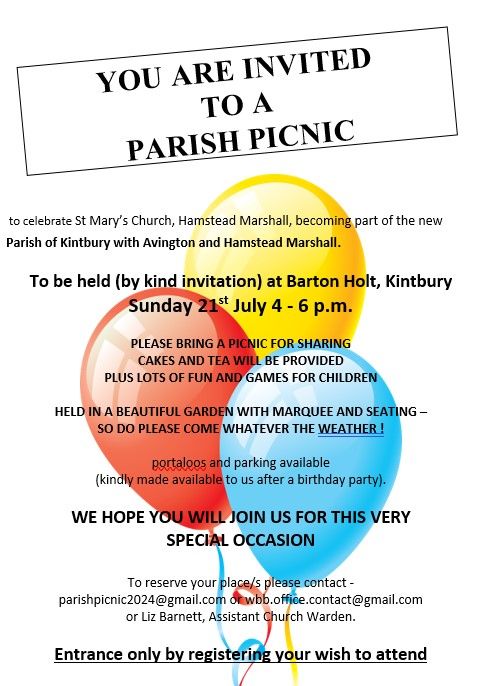
Parish Picnic, To celebrate St. Mary's Church Hamstead Marshall becoming part of the new Parish of Kintbury with Avington & Hamstead Marshall. Held on the 21st July between 4pm & 6pm, at Barton Holt in Kintbury. You DO need to reserve your space by contacting parishpicnic2024@gmail.com and copy in wbb.office.contact@gmail.com or alternatively contact Liz Barnett, Assistant Church Warden for St. Mary's Kintbury.
- Tamara Laing
- 07359 327072
Post election thoughts
Dear Friends,
The voting is over and today we start a new government term; you may be delighted
with the election results, disappointed, or just uninspired by the whole voting
process.
As Christians, we are reassured even if we are concerned about what may lie ahead
by reminding ourselves that our ultimate hope lies in the eternal kingdom of God.
Colossians 3:2 advises, “Set your minds on things above, not on earthly things.”
Whatever concerns we have going forward our faith and the everlasting hope in
Christ, lie beyond the temporal outcomes of any election.
So, I invite you to look at the general election from a Christian perspective and…
1. Begin today with prayer, asking for God’s guidance. and expressing trust in
His plan regardless of how you feel about the outcome. God is in control.
2. Pray for the newly elected leaders, asking God to grant them wisdom,
compassion, and integrity.
3. Incorporate prayers for the political leaders into your prayer routine, regardless
of whether you agree with their policies.
4. Reach out to friends or family members who may feel distressed or jubilant
about the results, offer a listening ear, and seek to understand their
perspectives without judgment.
5. Be respectful in any dialogue on social media and personal conversations.
avoiding inflammatory language and encouraging constructive discussions.
6. Commit to remaining informed about local and national issues and
participating in efforts to improve your community. Encourage others to take
positive, proactive steps as well.
7. Engage in self-reflection and prayer, asking God to help you exhibit humility,
patience, and love in all your interactions, especially when discussing politics!
By taking these steps we will be navigating the election outcomes with faith, hope,
and a commitment to positive action. We will be good witnesses reflecting God’s
love and purpose in our communities while maintaining faith and integrity.
God of all nations, we lift up to You our newly elected leaders and government
officials. Grant them wisdom, integrity, and a spirit of service as they undertake their
duties. May they be guided by a commitment to the common good, justice, and the
welfare of all citizens. Amen
With love and prayers
Revd Annette
- Revd. Annette Shannon
- 01488 646385
Thank you
'A huge thank you to everyone for making Mike and I so welcome at Inkpen on Sunday. It was lovely to be with you. The food was delicious, and the flowers are absolutely beautiful! I am very much looking forward to being with you over these coming months, as I get to know you and your communities. Alison'
- Alison Dean