Church Blog
News, Updates, Thoughts
The latest news, updates, and thoughts from Walbury Beacon Benefice.
9/11
At one time it was said, “You always remember where you were when President Kennedy was assassinated.” And I think it was true. But I suspect it has now been overtaken by, “Where were you / what were you doing, when the news broke about the Twin Towers?”
It happened on a Tuesday lunchtime: 1:46pm UK time, 25 years ago.
There are similarities between the two events: planned acts of human destruction of fellow humans; does the magnitude of the one, make it a more evil deed than the first? That’s a philosophical / theological discussion I don’t feel competent to conduct.
You may have guessed that I am actually writing this in the morning of the 11th of September – 9/11 as it is universally known. The news is full of ceremonies of remembrance, anecdotes from those who were in some way involved, the ongoing sadness of people who lost friends and relatives in one of the attacks. And still, a quarter of a century later, the searching for explanations, blame, retribution and revenge continues.
I suppose history has always been defined by disasters – whether generated by human or natural forces.
And yet for Christians – history = hope – succinctly and memorably summed up for us all by Paul in his first set of epistles to the somewhat wayward Corinthians:
Chapter 13, Verse 13: (KJV)
And now abideth faith, hope, charity, these three; but the greatest of these is charity.
If only humanity, through the centuries, would listen . . .
Jenny
- Jenny Veasey
- 01488 657911
50th Anniversary of Patrick’s Ministry
On September 26 next week, it will be the 50th Anniversary of my Ordination which took place in York Minster in 1976, and was conducted by Stuart Blanch who was then Archbishop of York. I was 25 and had been three years in training at Cranmer Hall, Durham where I did a Theology degree. Previous to that I had taken a history degree at Oxford and then worked in a business for a year in London. I had little knowledge of the world! But I had clearly felt and experienced the call of God to serve him in an ordained role, my faith having come alive whilst at Oxford.
The actual day of my Ordination which in the Anglican system is two tier - Deacon the first year and a year later being Priested – was indeed awesome! York Minster for a start is splendid. Family and friends were there to support, and there were members of the church where I would serve present too. The parish I served in had an outstanding preacher, evangelist and pioneer minister called Canon David Watson and he had an average congregation of 700! For ‘a wet behind the ears’ curate it was an overwhelming experience! But it showed me what is possible!
After three years in lovely York, I moved in 1979 to a church, which has since become well known through the Alpha Course, called Holy Trinity Brompton where I became Director of Lay Training preparing lay people to take part in leadership in the church. Between jobs Olivia and I got married and she has supported me wonderfully over 47 of these 50 years! In the early days I helped organise an Ecumenical Mission based in the Albert Hall called “To London with Love” led by David Watson. Peregrine Worsthorne (1923-2020) gave it rave reviews in the Telegraph! While at Holy Trinity I remember preaching on a number of important national occasions: at the beginning of the Falkland’s War making the case for a Just War, after the Harrods bomb in December 1983 and I even took a wedding in front of Princess Diana, the Queen Mother and Princess Margaret who all signed the registers. But when it came time to move (1984), I went to a very different area, and different clientele, which is part of the glory of the Anglican Ministry.
We moved to Christ Church Gipsy Hill, near Crystal Palace in Lambeth and stayed eleven years. The church building had burnt down in an arson attack 18 months before we arrived. I was now 33 and we had two children, Rachel and Louisa. The challenge was to help design a new church building adjoining the church hall where we worshipped for three years. The new Church building opened in 1987, Romanesque in style - you can see it on line today! We gradually filled the building with a congregation of about 200 in all, with people from all walks of life. The church now has a significant ministry among the Iranian or Farsi speaking community there. And later we bought back a daughter-church which had become a carpet warehouse, to turn it into a Church Community Centre. After 11 years, and now with four children including Sophia and David (spanning in all 5 to 13 years), we left for Bath Weston. We stayed there 21 years.
Weston is on the edge of the city of Bath with the main District Hospital in the parish, a large Church Primary School (about 350 pupils) where Olivia taught part time. The congregation was large about 300 adults and there were two small village churches as well. We had a big team and opened a refurbished Church Community Centre (once the village school) six years after we arrived in 2001 (and later we re-furbished the Church). In addition to teaching, preaching and schools work, I expanded my horizons in 2002 to include overseas mission and writing. During my Sabbatical in 2002 I indulged my love of travel, driving with a friend from Bath to Amman in Jordan and writing my first book, “Becoming Fully Human”. More journeys and books were to follow. In writing I have focussed on Biblical studies and Early Church History, for reasons I could explain. I also took members of the congregation on overseas missions -all to Africa, and did ten of these with an organisation of which I was Trustee called SOMA (Sharing of Ministries Abroad). We went at the invitation of the bishop of that area, and did a programme for his diocese. Since 2016 we have been delighted to help out in Walbury Beacon Benefice and other parishes nearby, and meet a whole new community! So, without saying more, it has been a rich and, I hope, fruitful 50 years!
Often people ask me about the Church of England today! We obviously face many challenges today from many directions: finances, staffing (ordinations), fragmentation, disinterest and so on. But I remain optimistic: human beings are basically the same – their need for hope, forgiveness, love and a nurturing community. Christ remains the same, always active: giving grace, hope, creating a community in which we may belong and a faith in him through which we can ‘become fully human’ – that is, all he wants us to be. My job as a minister for whatever years that remain, and the job of the church, is to bring the two together: human need and Christ’s answer. It is a lifelong mission, an adventure, endlessly interesting and never dull. Join the party! (Luke 15:31,32).
Next Sunday, September 27, we will be Celebrating these 50 years of ministry at a service of HC at Kintbury 10:00 am; do come along, if you can, to give thanks, and commit the future to God,
Warmest wishes
Patrick and Olivia Whitworth
- Patrick Whitworth
Harvest
I came back from a week or so away – to a busy couple of days and the memory – buried deep – that I had offered to provide a pudding for a “bring and share” lunch with a group of friends from my previous parish. Great – but it was tomorrow and I had not been shopping.
So . . .
I had stopped on the return journey to buy some cherries and ripe Victoria plums from a wayside stall on the A27. Right – that was a start.
Next – check the garden: plenty of windfall apples (a bit bruised in places but that’s ok). The rhubarb – suffering a bit from the drought and my absence from the watering can, but still productive.
What else? Ah, yes, walk the dog and pick a good crop of blackberries.
And back to the kitchen – local honey (Inkpen), flour from Doves’ Farm . . and butter and sugar – from goodness knows where.
It all made me think about our relationship with food – which is also our relationship with our planet. And if you believe in a Creator God that relationship has to be also with that Creator.
Then came broadcasts from Nepal; the devastation and tragedy from a collapsed glacier which reminded me of listening to the news, still in bed, one Boxing Day morning . . and learning a new word – tsunami.
The tsunami – perhaps – might have happened anyway – but a collapsed glacier – releasing water that has been securely frozen in the Nepal mountains for centuries/millennia – maybe longer? Climate change; global warming; they are not just words for activists – they are for all of us. And even more for the generations still to come.
When we celebrate, as we should, and as is right – our Harvest Festivals during the next few weeks – we must surely also look back on the last few months of unprecedented weather in this country and elsewhere. Lots of us – me included – have enjoyed the opportunities for spending time outside – in the garden, on the beach, swimming in the sea. And yet – every fine and sunny day had its dark side – what does the future hold for Planet Earth and its inhabitants? What has the third difficult growing season in a row meant for our farmers?
Read the Creation Story in Genesis. OK – it may not be scientifically accurate – but morally? Spiritually? “And God saw that it was good.” And He gave Adam – that’s politicians and world leaders, you and me – the stewardship of this good little corner of His good Creation.
Jenny
----------------------------------------------
This is a prayer from the Diocese of Oxford for the use of churches, parishes and benefices during a vacancy.
You may wish to use it at home, and to include it in our church worship.
Jenny
Gracious God, you are with us always.
We thank you for guiding us by your Spirit
through our life together as church.
We thank you for the ministry of Annette, supported by Dave,
and pray your blessing on them.
We pray that we may hear your voice in this time of vacancy;
give us patience, vision and courage as we seek a new priest
and as we become
a more Christ-like church, for the sake of God’s world:
contemplative, compassionate and courageous.
In the name of Jesus Christ, our Lord. Amen.
- Jenny Veasey
- 01488 657911
Day One of Retirement
Dear all,
Day One of Retirement.
I have woken up this morning with no sermon to write, no service to prepare, no emails demanding an immediate response and, most alarmingly of all, absolutely no idea what I am supposed to be doing. So I thought I would start by saying thank you.
I am still completely overwhelmed by your extraordinary generosity and by what was quite simply a wonderful send-off. You certainly know how to make someone feel loved — and, more importantly, how to make sure they leave before anyone has the opportunity to say publicly how much better things will be without them!
There were so many lovely things said about my ministry, but the truth is that very little of it would have happened without your encouragement, support, patience, kindness and, on occasions, your extraordinary willingness to overlook my shortcomings.
The day began with the 8am service at Kintbury, where I was amazed — and slightly alarmed — to discover that 31 people had managed to get themselves out of bed at that hour. I had rather assumed that retirement would mean never having to be conscious at 8am again, so it was a wonderfully appropriate way to begin my new life!
Sharing Communion with a gathering of people that represented so many different elements of the ministry we have shared together was deeply moving. It was a very special way to begin the day and a lovely reminder of the many people, places and moments that have made these years so rich.
And then came the surprise glass and hot cross buns. Frankly, I think this combination deserves much wider liturgical recognition.
Thank you so much to Christine and Emma for organising the surprise — and, even more impressively, for managing to keep it secret from me. I clearly need to sharpen up my powers of observation.
Then, in the afternoon, came the wonderful service at Inkpen. I only just managed to hold it together, particularly when the pop-up choir from around the benefice sang that very special blessing for me. It was an absolutely beautiful and deeply moving moment — although I have to say that it was a fairly ruthless way of ensuring that a retiring priest has absolutely no remaining control over their emotions.
The party afterwards at the beautiful Barn in Inkpen was equally special. Thank you so much to Richard and Jackie Atherton for their hospitality and to everyone who supplied the food and the young people who served us all. What a wonderful gathering. I was incredibly touched by the personal, individual gifts and completely overwhelmed by the astonishing generosity of the cheque.
Someone commented that it would definitely enable another visit to Butlins! I am very grateful for the confidence you have shown in my ability to spend it wisely. However, I think we will probably save it for something a little less noisy, slightly more sophisticated and rather more special — something that will give us a lasting reminder of our wonderful years with the benefice.
I have left my address with Tamara to pass on to anyone who requests it, and I genuinely hope you will come and see us if you are ever in the vicinity. We would genuinely love to see you. On Saturday a churchwarden and his wife from my previous benefice in Suffolk called round to see us and it was such a delight to catch up.
Shrivenham is a lovely village with a beautiful gift shop, an interesting community hub and a variety of other shops, conveniently close to Cirencester and with a regular bus into Oxford and close to both sets of grandchildren — so we feel very blessed.
Thank you, for the countless kindnesses, friendship, laughter, prayers, conversations, cups of tea, practical help, encouragement and shared adventures over the years. It has been an enormous privilege to be part of the life of this benefice. I have been blessed by the people I have met, the friendships I have made and the ministry we have shared together.
And so I should probably finish with the words of the sending out that I was supposed to deliver with some degree of professionalism at the end of my final service — but which, by that stage, had rather comprehensively defeated me.
So, on Day One of Retirement, I shall have another go:
“Go in peace to love and serve the Lord.”
Go with my love and enormous gratitude. And may God bless you all.
I shall miss you enormously.
With huge thanks, much love, and every blessing,
Annette
- Revd. Annette Shannon
- 01488 646385
A Pastoral Letter from Butlins
Dear Friends,
Greetings from Butlins, where David and I are spending a few days with our two grandsons, aged 10 and 7.
As the planned writer of this week has dropped out I have to write my pastoral letter from here. It is always good to remember that ministry can happen anywhere—and partly because, having paid the Butlins prices, I feel I ought to get some spiritual value out of the experience!
The Bible tells us in Ecclesiastes that there is “a time to weep and a time to laugh, a time to mourn and a time to dance.”(Ecclesiastes 3:4)
I can certainly confirm that there is plenty of noise at Butlins. There is also a fair amount of queuing, negotiating, eating, losing things, finding things, and answering the question, "Granny, what are we doing next?”—usually before we have even finished doing what we are doing now.
Spending time with a 10-year-old and a 7-year-old is a wonderful reminder of the gift of the present moment. They are not particularly interested in what happened yesterday or what might happen tomorrow. They want to know what is happening now.
And perhaps there is something very Christian about that.
Jesus reminds us not to worry excessively about tomorrow, but to trust God with each day as it comes. As He says in Matthew 6:34, "Therefore do not worry about tomorrow, for tomorrow will worry about itself.”
That is easier said than done, of course. Especially when you are responsible for two boys who have just discovered the swimming pool, the arcade, and the enormous amount of ice cream available on site!
But there are moments when the simplest things become precious: watching the boys laugh, seeing their excitement, sharing a meal, or simply sitting together after a busy day. These are small glimpses of the goodness of God.
Perhaps holidays remind us that we are not machines. We need time to stop, to laugh, to play, to enjoy one another and to notice the blessings that God has placed around us.
So, from Butlins, surrounded by families, entertainment and two energetic grandsons, I pray that you too may know something of God's joy and peace this week.
And if you are wondering whether I have managed to relax, the answer is yes.
I have just had ten minutes sitting down.
One grandson has asked when we are going swimming.
The other wants to know what's for lunch.
So perhaps I had better finish here!
With every blessing,
Revd Annette
- Revd. Annette Shannon
- 01488 646385

A pilgrim journey
Last month I shared with you a little of my experience of walking across the pilgrim route to the Holy Island of Lindisfarne. It was such a special moment that I am still basking in the memory of it from time to time.
It’s very easy to feel lifted by the astonishing beauty of the natural world. To feel one’s heart expanding in the space offered by total solitude. Christians over centuries have described ‘thin places’, places that have been steeped in prayer for so long that somehow it seems easier to feel the presence of God. A sense of heaven and earth touching each other.
But what about when we step back into the everyday, return to the challenges, the demands, the noise, the busyness? Is it inevitable that we lose something, leave it behind, consign it to memory? I wonder how we might continue to make that pilgrim journey in our ordinary, daily lives. In fact, I would go further and suggest that the more demanding our ordinary lives are, the more vital it becomes to somehow carve out that space to be nourished, replenished, and to rest quietly in prayer. Prayer can so easily become just another thing on the ‘to do’ list, something else to feel guilty about, if we judge that we don’t do it very much, or do it very well. But what if, sometimes, prayer is less about ‘doing’, and more about stopping ‘doing’ for a moment.
Jesus himself seems to have had a habit of stepping aside, and instructing his disciples to do the same. ‘Come away to a deserted place all by yourselves and rest awhile’ (Mark 6.31). And of course, famously, when asked by his disciples to teach them to pray, Jesus replies ‘Whenever you pray, go into your room and shut the door and pray to your Father who is in secret’ and then he gives them the simple but profound words of the Lord’s Prayer as a timeless guide (Matt.6.6). And of course, there are times when there really are no words at all, and we have to rely on the Spirit within us who ‘intercedes with sighs too deep for words’ (Rom 8.26).
It’s easy, when we have the luxury of time, or we have somewhere beautiful to move us to praise. But perhaps can we cultivate a habit, at any time, and in any place, of simply taking a moment to divert our attention away from the seemingly irresistible demands of our day-day-day, the incessant chatter in our own minds. To take a few really long, deep breaths. Just a moment to ‘Be still before the Lord, and wait patiently for him’ (Psalm 37.7).
- Alison Dean
Change
They're changing guard at Buckingham Palace -
Christopher Robin went down with Alice.
"Do you think the King knows all about me?"
"Sure to, dear, but it's time for tea,"
Says Alice.
A.A. Milne’s delightful poem full of whimsy and hidden truths. Well, this week we have seen another change of the political guard: same party but a different style. And once more we saw the lectern or no lectern outside 10 Downing St. This time no need for a brolly except for shade as the brilliant sunshine continues and a hosepipe ban begins to halt the flow of water to gardens. And the King might be forgiven for muddling the names of PMs as he has had four in his short reign so far.
Nevertheless, a change of leader is a fact of human life whether monarch, PM and for us in the Walbury Beacon Benefice, our Vicar. So next month we will have to say goodbye to our esteemed pastor and vicar, Annette and her family. Her leaving Service is at Inkpen on August 30 at 5pm and all are very welcome. We are grateful to all that she and Dave have brought us: a real grip on the running of our Benefice, a high standard of worship and ministry in our Sunday services, care and compassion in moments of need and special attention to the very young and the much older and real joy in celebrating our faith in many ways. We are grateful for all this and expect to build on these foundations in the future.
‘Succession’ is not just a brilliant TV series aboiut a media empire (which sadly I did not or have not seen) but a common occurrence in the Bible: Joshua after Moses, Elisha after Elijah, Solomon after David, and of course the Apostles after Jesus. All these moments were growth points; times to renew our trust in God, to look prayerfully to the future, to learn from the past and to discern the way forward for our community. We will need to be doing all these things together and will be led by our Church Wardens, Patron – Harry, and Alison our Curate. Together we hope to change guard effectively. And one last thought from A. A. Milne’s lines, “Do you think the King knows all about me?” asks Christopoher Robin. Well another King knows all about us here in this Corner of West Berkshire, after all he has got the whole wide world in his hands.
So, let’s put on the kettle and have a cup of tea!
Patrick
- Patrick Whitworth
Why do people still come to Church.
Dear Friends,
One of the greatest joys of parish ministry is sharing life's most significant moments with people. There is something deeply moving about standing beside a family as a child is baptised or watching a couple make their marriage vows before God. These occasions are filled with emotion, hope, laughter, and sometimes a few happy tears.
In recent weeks I have been reflecting on a question I am occasionally asked: Why do people still come to church for weddings and baptisms when there are so many alternatives available?
After all, couples can marry in hotels, stately homes, barns, gardens, and a host of beautiful venues. Families can hold naming ceremonies for children without any religious element at all. Yet year after year people continue to come through the doors of our churches.
The answer, I think, lies deeper than tradition or aesthetics.
Of course, our churches are beautiful places. Many of them have stood at the heart of village life for centuries. Their walls have witnessed generations of baptisms, weddings, and funerals. They connect us to those who came before us and remind us that we are part of a story larger than ourselves.
But there is more to it than that.
When I meet couples preparing for marriage, many are not regular churchgoers. They are often honest about that. Yet almost all speak about wanting something more than simply a legal contract or a wonderful party. They want their wedding to mean something. They want to make promises that carry weight and significance. They want to stand somewhere sacred and declare their commitment not only before family and friends but before God.
In a world where so much feels temporary, there remains a deep human longing for permanence, faithfulness, and blessing.
The same is true of baptisms. Parents often tell me they want to give their child the best possible start in life. They speak of hope, love, belonging, and values they want to pass on. Sometimes they struggle to put it into words, but beneath it all lies a recognition that a child is a gift and that life itself is precious.
A baptism is not simply a family celebration. It is a declaration that this child is known and loved by God. It is the beginning of a journey of faith surrounded by the prayers and support of the Christian community.
Perhaps what surprises me most is how often people who rarely attend church nevertheless possess a genuine spiritual hunger. They may not describe themselves as religious, but they still ask life's biggest questions. They still wonder about meaning, purpose, love, suffering, and hope. They still seek God's blessing at important moments.
The church is privileged to be there when those moments arrive.
One of my favourite parts of a wedding service comes when the bride and groom hold hands and make their vows. For a few moments the busyness of life falls away. Everyone present recognises that something profound is happening. Two people are promising themselves to one another for better, for worse, for richer, for poorer, in sickness and in health. Those words have endured because they speak honestly about life and courageously about love.
Similarly, when a baby is brought to the font, surrounded by parents, godparents, grandparents, friends, and family, there is a palpable sense of joy and possibility. We are reminded that every human life is precious and that every new beginning is worthy of celebration.
These occasions also remind us of something important about the Church itself. We are not simply a gathering for Sunday mornings. We are here to accompany people through every stage of life: birth and death, celebration and sorrow, certainty and questioning. The parish church belongs to the whole community.
That is why I never regard a wedding couple or baptism family as outsiders looking in. Rather, I see them as people responding to a quiet invitation that God has perhaps been placing on their hearts for many years.
Many who come for a wedding or baptism may not yet realise how much faith matters to them. Yet they sense that the church offers something that cannot be found elsewhere—a connection to God, to community, to history, and to hope.
And perhaps that is why, despite all the alternatives, people still come to church.
For behind every wedding, every baptism, and indeed every service we hold, stands the same truth: God delights in people and longs to bless them.
That is something worth celebrating.
With every blessing,
Revd. Annette
- Revd. Annette Shannon
- 01488 646385
‘One pole at a time….’
A few weeks ago, on holiday in Northumberland, I had the opportunity for a ‘bucket list’ experience – to walk across to the Holy Island of Lindisfarne on the ancient pilgrim route across the tidal sands. Holy Island is cut off from the mainland by the sea with just two short windows each day when the tide recedes far enough to make it safe to cross. Whilst there is now a concrete causeway for vehicles, the old pathway, used by St Aidan and St Cuthbert, and countless others since, is marked simply by wooden poles spaced regularly in the sand, and a couple of rickety platforms on stilts on which those who get caught out can take refuge until the next low tide.
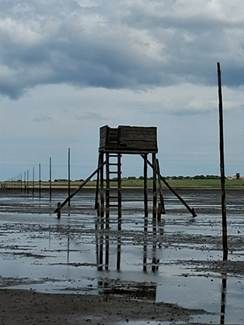
Metaphors and analogies of the life of faith and spiritual journey abound, so I will simply tell the story of my adventure and let you make of it what you will.
I checked the tide times at least a dozen times. Could I trust that the scientists have got it right, and that the moon and the tides and the wind and the waves would perform according to schedule? I did my research, read all the warnings. I knew to look out for the dark patches – the sinking sand! To give them a wide berth, but always return to the next pole, never deviate!
I wanted to make this crossing on my own, but as I stepped out onto the sand and began to move across into what is essentially the exposed seabed, the sense of solitude was astounding. After a mile or so, I turned to look back at the very distant shore line. My destination was a similar distance ahead. I felt utterly vulnerable, and yet perfectly peaceful. The sky seemed huge above me, the sands stretching out into the open sea. And apart from the gentle wind and the distant calling of seal pups, the sound of sheer silence!
Having made good progress and increasingly confident that I was not going to slip over in the mud and break an ankle, it was time to take off my boots, and finish my walk with real Holy Island sand and sea between my toes.
My beautiful experience is now a memory, but the question remains. What are the poles that I need to stick close to, on my journey? What, or who, can I really trust? What, or who, will help me navigate safely when it is impossible to see the path more than a few strides in front? Sometimes, we just have to walk ‘one pole at a time’. I leave you to ponder….
- Alison Dean
Time does not stand still
Dear Friends,
July often brings a shift in pace. The days are at their longest, gardens are in full bloom, schools begin their summer break, and for some there is the promise of holidays or time with family and friends. For others, life continues much as before, perhaps with added pressures as routines change around them. Either way, summer has a way of gently reminding us that time does not stand still.
In the Christian tradition, rest is not seen as a luxury or an afterthought, but as something built into the rhythm of life itself. The idea of “Sabbath” speaks of pause and restoration—a time to step back, breathe, and remember what really matters. Bishop Mary has recently commended Nicola Slee’s book Sabbath: The Hidden Heartbeat of Our Lives (Kindle Edition), which reflects on this very idea. It suggests that rest is not simply about stopping work, but about recovering a deeper sense of balance, meaning, and connection in our lives.
Jesus himself understood the importance of rest. In the Gospel of Mark, he says to his friends, “Come away… and rest a while” (Mark 6.31). Even in the midst of busy and demanding times, there is wisdom in stepping aside for a moment to be renewed.
Of course, summer is not restful for everyone. For those who are coping with illness, bereavement, loneliness, financial worries, or caring responsibilities, this season can sometimes feel heavier rather than lighter. If that is your experience, please know that you are not forgotten. Many people in our community are thinking of you, and you remain in the prayers and care of the local church.
July also offers the chance to notice the world around us. Whether it is a garden, a park, a walk through the countryside, or simply a moment at a window, there is much to observe in the life of creation. Growth, colour, and abundance can invite us to pause and appreciate the everyday gifts that are often overlooked.
In the midst of all this, small acts of kindness continue to matter greatly: checking in on a neighbour, sharing a conversation, offering help where it is needed, or simply taking time to listen. These ordinary gestures help hold a community together.
As we move through July, perhaps we might each find moments—however brief—to rest, to notice, and to reconnect with what gives life its depth and value.
With best wishes for the month ahead,
Revd Annette
- Revd. Annette Shannon
- 01488 646385