Church Blog
News, Updates, Thoughts
The latest news, updates, and thoughts from Walbury Beacon Benefice.
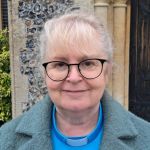
Gathering around the manger this Christmas
My dear friends,
As we prepare to gather around the manger this Christmas, I’m struck by just how much has changed during 2025. We are all a year older (some of us more willing to admit it than others!), yet with that passing of time comes a deeper sense of who we are as a church and as a community.
Across our country, we’ve seen moments of real transition. A new Archbishop of Canterbury, Dame Sarah Mullally D.B.E., brings a fresh voice of faith and encouragement to the Church of England. Here in our diocese, our new local Bishop, Mary Emma Gregory (Bishop of Reading), is guiding us with wisdom and care, supporting parishes like ours as we grow in faith and serve our communities. Like the nation, we’ve been adjusting to changes—with hope—and always with that distinct British determination to keep calm and carry on.
Here in the parish, we’ve seen encouraging signs of renewed life. New faces have joined us, familiar ones have stepped into new roles, and long‑prayed‑for ministries have begun to take shape. There’s a quiet sense of movement—God gently nudging us forwards, reminding us that His Church is very much alive.
In our homes, life has unfolded in its own beautiful way. Many of you have welcomed new grandchildren or great‑grandchildren, little bundles of joy and determination. Others have been joined by furry babies, whose wagging tails or whiskered noses know just when we need comfort. These new arrivals soften our hearts and remind us that love is always arriving fresh.
Christmas, with its old‑fashioned nostalgia, carries a similar gift. Familiar carols, the glow of fairy lights, and decorations unpacked year after year all remind us of stories, people, and traditions that have shaped us. Yet Christmas is not just about looking back. It is about Emmanuel—God with us now. In a world that moves quickly and often feels unsettled, the birth of Jesus anchors us in hope that does not fail.
As a parish, we continue to discover the strength of community: neighbours checking in on one another, people quietly helping behind the scenes, and a rising willingness to be there for those who need a warm welcome or listening ear. This is the heartbeat of the Gospel lived out day by day.
So as we step into 2026—older, perhaps wiser, and hopefully a little kinder—may we carry with us the message that began in a stable: that light shines in the darkness, love is stronger than fear, and God’s future is always bigger than we imagine.
May the year ahead be a blessing for you and your loved ones, whether grandchildren, great‑grandchildren, or the furry members of the family. And may our church continue to grow in faith, courage, and joyful hope.
Wishing you a peaceful, blessed, and very happy Christmas.
With love and prayers,
Your Vicar, Annette
- Revd. Annette Shannon
- 01488 646385

St. Andrews Day
Advent Sunday is also, this year, St Andrew’s Day, as you will certainly be aware if your family hails from North of the Border where the National Day is celebrated with a public holiday – unlike poor old St George of England.
I’m glad St Andrew gets a proper festival day all to himself – I can remember as a child feeling rather sorry for the Andrew of the Gospels; he seemed always overshadowed by his lively, outspoken brother Peter and the two “Sons of Thunder”, as Jesus nicknamed the volatile James and John, and was not included in the really close occasions with Jesus, such as the Transfiguration on the mountain, and the vigil in the Garden of Gethsemane.
And yet – he has his moments in the Gospel stories. It was Andrew, remember, who in John’s Gospel responds to Jesus’ invitation “Come and see” right at the outset of Jesus’ ministry; later, bursting with excitement he searches out his brother with the prophetic and insightful exclamation: “We have found the Messiah!” (In the Eastern Orthodox tradition he is known as Protokletos – the First Called.) It is Andrew who locates the boy with the loaves and fishes – although he discounts the potential value of the offering – “but what are they, among so many?”. He was, of course, present at the Last Supper; after the Ascension he gets one mention in Chapter 1 of the Acts of the Apostle – the rest is Biblical silence, enhanced and embellished by legend, early writings and folk lore, including his supposed crucifixion in the Roman province of Achaea, Greece, on the diagonal cross which became his symbol.
I was brought up on folk tales, myths, legends. And yet when I started thinking about St Andrew, I realised that I didn’t know why, or how, he became Patron Saint of Scotland. So I did a bit of reading; it’s an interesting and ancient little story – with perhaps a bit more credibility than many such. In 832 the Picts and Northern Celts were fighting off an invasion from the Saxons, from south of the Border (yes, I’m afraid that is us Sassenachs). They were heavily outnumbered, and on the eve of battle, their leader, King Angus (Óengus II) prayed for divine help. As he finished his prayer, he looked up at the sky – to see a white cloud pulled into the shape of a diagonal cross, which he understood to be a sign from St Andrew. Against all odds, the Scots were victorious and so Angus called Andrew the Patron Saint of Scotland and adopted the Saltire (the white diagonal cross against a blue background) as the National Flag. Andrew was venerated – but informally – by the Picts and the Celts over the next 500 years; then in 1320, following the Declaration of Arbroath, demanding Scottish independence from Pope John XXII, Robert the Bruce formally proclaimed Andrew as the Scottish Patron Saint. This was considered a politically astute move, given the significance of Andrew’s brother Peter to the Catholic Church, helping to promote a different relationship between Scotland and the Pope.
There are also, inevitably, numerous stories about Andrew (often involving miraculous escapes from shipwrecks, and other supernatural events) describing how, over the centuries, relics of the saint were brought to Scotland where they were enshrined and became pilgrimage sites.
So on Advent Sunday this year, in among our contemplation of the Advent message and mysteries, let us also remember Andrew: Saint, Apostle – the first to recognise Jesus – possible martyr and the protector of the Scots.
A very blessed and contemplative Advent to you all
Jenny
- Jenny Veasey
- 01488 657911
Community and Gratitude
Dear friends,
As the days grow shorter and autumn deepens around us, our parish life continues to be full of faith, warmth, and hope. It has been such a joy to see our churches filled these past weeks—moments that remind us that God is very much at work among us.
Last weekend’s five Remembrance services across our Benefice churches were truly moving. Attendance was up in every church, and there was a deep sense of community and gratitude. It was particularly heartening to be joined by so many uniformed young people, whose respect and attentiveness were striking. They stood shoulder to shoulder with veterans and families in quiet honour of those who gave their lives for peace.
On Monday 11th November at 11 a.m. in Kintbury, the whole school gathered in the Churchyard alongside the community. Young people read the roll of honour and a poem before the two minutes’ silence—a powerful and reverent act of remembrance that left many of us deeply moved. They had also created a display in church about the impact of the war in Kintbury. It’s encouraging to see such understanding and compassion in the next generation.
The introductory Youth Alpha runs for the next two Sunday evenings, offering our young people space to explore faith in a welcoming and open way. The full course will continue after Christmas. Please pray for those taking part and for our leaders, who are guiding the sessions with such enthusiasm and care.
In January, we’ll be launching the Adult Alpha course on Tuesday evenings, a chance to begin the new year with fresh conversations about faith, purpose, and life. Whether you’ve been coming to church for years or are simply curious, Alpha is a wonderful way to explore questions that really matter. As C.S. Lewis once wrote, “Faith is the art of holding on to things your reason has once accepted, in spite of your changing moods.”
As we turn our thoughts toward Advent, that season of watching and waiting, we’re reminded that preparation begins within. “Prepare the way of the Lord” (Isaiah 40:3) isn’t just an ancient call—it’s an invitation for each of us today to make space for Christ in our lives. Even a few quiet moments each day can help us rediscover hope amid the busyness of the season.
We also look ahead prayerfully to the national budget next week, aware that its outcomes will bring concern for many. “Bear one another’s burdens, and so fulfil the law of Christ” (Galatians 6:2). As a community, let us continue to be alert to those who may feel the strain, offering both prayer and practical help. Our ongoing support for the food bank and community care remains a vital expression of our shared faith in action.
So, as November draws on, let us keep praying, preparing, and caring. God is with us—in remembrance, in our young people, in our shared life, and in the quiet hope that Advent brings.
With every blessing,
Revd. Annette
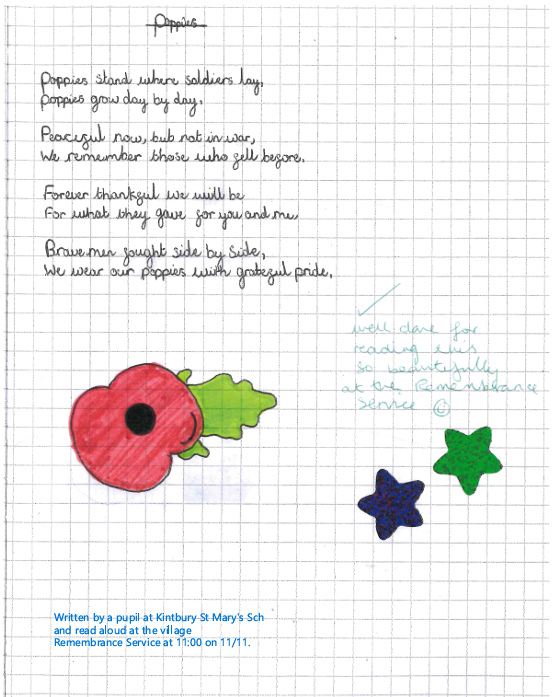
Written by a student at Kintbury St. Mary's Primary School
- Revd. Annette Shannon
- 01488 646385

Reflection
I recently spent a week in a dearly loved bolt hole in the countryside, in a place that I find so exquisitely beautiful, peaceful, and full of precious memories, that it is an emotional wrench to leave it. If only it were possible to bottle the experience, bring it back, and hold on to it forever!
This caused me to reflect that when we feel things deeply, when we care, when we love, and allow attachments to grow, alongside comes the possibility, indeed the inevitability, of loss and sadness. And yet, what are we to do? We are created with the capacity and the longing for love. As creatures made in the image of God, who is love, it is in our spiritual ‘DNA’. Our recent Bereavement Service offered a space for us to acknowledge that with love can come great pain, and we were gathered to ask for God’s help to bear this. Dare we trust that when we suffer loss, or the pain of the lack of love, we are somehow held within an even greater love, the Psalm 23 kind of love? Believe that there is One who walks invisibly, silently beside us in the darkest of valleys?
The words of the hymn ‘O Love that wilt not let me go’ came to my mind, and unable to recall all of the words, I looked it up. My curiosity piqued, I investigated its origins. It was written in 1882 by George Mattheson, on the eve of the wedding of his sister. He tells of how the words felt to be ‘dictated by an inward voice’ at a time of ‘severe mental suffering’. Some years earlier, as a young man, George had begun to go blind, and his fiancé had broken off their engagement, unable to bear the thought of going through life with a blind husband. He never subsequently married. We can only imagine his feelings of loneliness and rejection, resurfacing as he prepared to share in his sister’s joy. He bore multiple losses - of his sight, of his beloved, and of his future as he had imagined it to be. And yet, in the midst of his anguish, he was inspired to write this:
O love that will not let me go,
I rest my weary soul in thee;
I give thee back the life I owe,
That in thine ocean depths its flow
May richer, fuller be.
O Light that follows all my way,
I yield my flick'ring torch to thee;
My heart restores its borrowed ray,
That in thy sunshine's blaze its day
May brighter, fairer be.
O Joy that seekest me thru' pain,
I cannot close my heart to thee;
I trace the rainbow thru' the rain
And feel the promise is not vain
That morn shall tearless be.
O cross that liftest up my head,
I dare not ask to fly from thee;
I lay in dust life's glory dead,
And from the ground there blossoms red
Life that shall endless be.
Words that might offer us a way to pray, when we don’t have sufficient words of our own.
Alison
- Alison Dean
Acts of Courage, Seeds of Peace
Acts of Courage, Seeds of Peace
Peace is often spoken of as something distant—a goal for nations, a hope for the future. Yet, as Jesus wept over Jerusalem, we are reminded that peace begins much closer to home. It starts in hearts and homes, in the small acts of courage, kindness, and care we show every day.
Looking at the world today, it’s easy to feel despair. Cities are torn apart by conflict, and communities grieve. Yet even in the darkest moments, glimpses of peace shine through—in those who risk themselves to protect others, in those who offer help without expectation, in those who act bravely when it matters most.
Even in our own country, acts of courage remind us that peace and protection are lived, not abstract. Just last week, on a train approaching Huntingdon, passengers were seriously attacked in a shocking stabbing. Amid the fear and chaos, members of the public and train staff acted with bravery and selflessness, helping to protect others and assist the injured. Their courage in the face of danger reminds us that peace is not just the absence of harm—it is the presence of care, courage, and compassion.
In our villages and towns, peace is also made through quieter, faithful acts. Volunteers supporting veterans, neighbours helping each other, and young people learning the value of service—all these acts strengthen our communities. Here in our own area, the Royal British Legion has long played a vital role. People like Doreen Ainsley, who for decades has collected poppies and supported veterans, show that small, committed acts can have a lasting impact.
Peace is rarely achieved through grand gestures alone. It begins in ordinary moments: listening, helping, standing up for what is right, and nurturing compassion in the next generation. It is about living in a way that honours those who have gone before us and shaping a world guided by love, respect, and fairness.
In a time when headlines often tell of division and loss, it’s easy to overlook the small victories of peace. Yet they are all around us—in families, in friendships, in communities, and in the courage of people willing to act when it matters most.
True peace is not a distant goal—it is something we build every day, together. And this Remembrance, as we honour those who gave their lives and those who continue to serve, we are reminded that courage, care, and service are what keep peace alive.
Revd Annette
- Revd. Annette Shannon
- 01488 646385
The Light Shines in the darkness
Dear Friends,
As we begin the week of 31st October, Halloween is all around us — a time when children dress up as ghosts and witches, and we play with the idea of fear and darkness in a safe, fun way. Halloween originated from ancient Celtic festivals, particularly Samhain, which marked the end of the harvest and a time when people believed the boundary between the living and the dead was thin. Over time, it merged with Christian traditions such as All Hallows’ Eve, the night before All Saints’ Day.
As Christians, we can engage with Halloween thoughtfully. While enjoying costumes and pumpkin lights, we are reminded that the darkness we play with is not the same as the real challenges of life. We are called to shine God’s light in the world — through acts of kindness, compassion, and courage — and to remember that even small gestures can bring hope and warmth to those around us.
The Bible reminds us:
"The light shines in the darkness, and the darkness has not overcome it." (John 1:5)
This week, as children delight in playful frights and communities light up with candles and lanterns, let us also remember that God’s light shines in every real shadow. May we reflect that light in our words and actions, offering love and hope wherever it is needed.
With every blessing,
Revd Annette
- Revd. Annette Shannon
- 01488 646385
Paths
Some years ago, with the help of others I set up a personal website. It’s still out there and it is called Routes that Refresh with my name attached! It is a play on words: roots/routes! It contains the message that deep roots come from using well-travelled routes. And to underline this I chose a verse from Jeremiah:
“Thus says the Lord, ‘Stand at the crossroads, and look, and ask for the ancient paths where the good way lies: and walk in it, and you will find rest for your souls’” Jeremiah 6:16.
The origins of an ancient path are interesting. Behind our house across the field, you can spot paths made by animals; hares, deer and badgers quite possibly. They run down the field and through hedges and are well worn, but are too small for humans. Additionally, these paths go through places where we would be trespassing. Walker’s paths are marked on maps, or with signs, as footpaths, bridleways or lanes. They are legally enforced and are for walkers a glory of the English countryside, peculiar to our nation and which you will not find in France or Germany. It says something about the rights of the ordinary walker vis a vis the landowner: the give and take of access to the countryside.
A step up from footpaths and their various definitions for differing modes of travel (eg feet, cycles, horses or vehicles) are roads which also come in many forms: from a narrow country lane to a motorway. They carry different speed restrictions and types of traffic. Some of these roads or paths are truly ancient going back, like Ermine Street, to Roman days and so have seen two thousand years of use already. They are indeed, “ancient paths.”
Paths or roads, as our verse from Jeremiah implies, require choices and this is no clearer than at a crossroads. Indeed, the very thought is a metaphor for living. We sometimes say, “I am a crossroads”, meaning I could take several routes from here. Well, four to be precise: go back the way I came, go straight ahead, or left or right. Faced with that choice we need to know where we are going and whether the path will get us there, else we could get lost! Surely that is a parable too!
Jeremiah tells us when we are at a crossroads, we need to take a tried and tested path, one that is commended to us. In his words we are to look for the “ancient paths”. For me, these paths are to be found in the Scriptures with wisdom going back at least three thousand years but encapsulated especially in the teaching of Jesus and the call to faith in him. Furthermore, in recent years, I have written too about the teaching and lives of the Church Fathers who lived in the first five hundred years of the Church’s life. They too were journeying, often struggling to express the faith in the context of their times, and often facing persecution. They sought to interpret ‘the ancient paths’ for their day and for those who came after them. Walking in these ancient paths of wisdom, Jeremiah said would bring rest to our souls. How wonderful! And this promise reflects Jesus’ own words, “Come to me, all you that are weary and are carrying heavy burdens and I will give you rest. Take my yoke upon you, and learn from me; for I am gentle and lowly in heart, and you will find rest for your souls for my yoke is easy, and my burden is light” Matthew 11;28-30. Surely more than anything else that is the incentive to seek out the ancient paths. Good travelling!
Patrick Whitworth
- Patrick Whitworth
The Changing Seasons
In what seems like no time at all I find myself in the second year of my curacy here in Walbury Beacon! Once again, the nights are drawing in, the natural world is changing colour, and after a recent Harvest Service it occurred to me that things are coming up that will not be ‘firsts’ for me anymore. Soon we will mark All Souls, with our special bereavement service, then Remembrance Sunday, and in no time at all I will enter my second Advent season here with you, and the beginning of another liturgical year.
As my faith journey did not begin in the Anglican tradition, I used to find it rather odd that year after year we seem to celebrate or in some way mark the same thing, around the same time of year, over and over again. Isn’t that just tradition for traditions sake, a bit rigid, predictable, rather boring?
But as I have begun to appreciate the gentle rhythm of the changing seasons in the church, it has occurred to me that each of the special days, events and seasons speak to us of something that God has done, and is doing in our world. Every occasion tells us a story, of God’s on-going involvement in our world. Harvest speaks to us of God’s creative and regenerative power, of his bountiful provision for us, and his mandate to share what we have, and as we are blessed, to pass that blessing on to others. As the natural world around us appears to wither and fall dormant, it hints at the death and resurrection of Christ which is so fundamental to our faith. This leads us into a time of deep reflection, allowing ourselves to remember, and to grieve, for those who have gone before us, and to have hope in that resurrection life and the promise that God will make all things new.
It is easy to see how the big events – Advent, Christmas, Easter – tell the Christian story, but if we look a little more closely, perhaps the smaller festivals can also be mined for deeper meaning, for their spiritual and indeed personal significance. As humans we can tend to have short memories, we need markers, reminders, points of reference. This is not a modern phenomenon: in the Old Testament there are a number of accounts of people setting up memorial stones to remind them of something particular that God had done, a reminder of his faithfulness (if you like a bit of OT study, have a look at Gen.28.10-22 or 1 Samuel 7.7-12 for some fascinating little stories!).
Our special seasons and services are one way of ‘setting up a stone’, placing a marker, creating a space in which to remember God’s action in and for our world. So, a challenge for us all as the liturgical cogs keep on turning, to not fall into thinking ‘same old, same old’, but to reflect and seek out meaning, perhaps dig a little deeper, and notice something we hadn’t seen before, as we enter each new season.
- Alison Dean
Bishop Sarah
I really do want to apologise for the length of this weekly letter – it’s rather a big ask, I know!
It is not the letter I had drafted 10 days ago, on an entirely different subject – but last Friday’s announcement from the CNC made me rethink, and do a little research, which I share with you.
Bishop Sarah; the Rt Revd and Rt Hon Dame Sarah Mullally, DBE, Archbishop of Canterbury designate – “primus (or I suppose, in this instance – ‘prima’ ) inter pares”: “first amongst equals” – has something of a history of “firsts”:-
She was the youngest person to be appointed as Chief Nursing Officer, NHS England, in 1999; one of the first two women to be consecrated as bishops at Canterbury Cathedral in 2015; as Bishop of Crediton later that year, the first woman to conduct an ordination; from 2018 the first woman Bishop of London (the third-ranking post in the Church of England); and in March next year, she will become the first woman Archbishop of Canterbury – the head of the Anglican Community worldwide, as well as of our own familiar CofE.
This announcement a week ago, was for many members of the Church, a matter of great rejoicing; for others, a deep sense of sadness and even betrayal.
Why is the election of a female Primate so controversial and divisive in these days when gender equality is now enshrined in the law** – of this land, at least? The reasons, of course, are complicated, rooted in centuries of ecclesiastical history and deeply embedded in the faith of many individuals, groups and national churches.
One issue – mainly, I believe, for those within, or verging on, Roman Catholicism – is the view that a priest is the earthly representation of Jesus for his flock; Jesus was male, therefore a female cannot embody his representation and so cannot fulfil the principal role of priesthood.
Another is the theology of Apostolic Succession. This depends on the fact that the Twelve whom Jesus chose as his Apostles, to be his successors after his Ascension, were all male. Well, yes – in that totally patriarchal society – he did not have a lot of choice. It was OK – just – for a band of blokes to go wandering around the Galilean countryside, sleeping rough if necessary and dependent on the hospitality of strangers in the towns and villages for board and lodging.
But for a woman? She would have been publicly shamed and probably stoned to death.
As the centuries rolled by, those male Apostles appointed other male disciples as deacons and Church leaders, who in turn appointed their male successors – and so on, according to the theory, in an unbroken line of male Priesthood. Every priest thus appointed can, it is argued, therefore trace his ordination directly back to the Apostles and through them to Jesus himself. And any intervening female breaks the chain, invalidates the consecration and irretrievably contaminates the one who performed it.
Other beliefs which have been cited as forbidding the ordination of women are founded on words and injunctions in the Bible itself, eg:
· 1 Timothy 2:11‒14: “Let a woman learn quietly with all submissiveness. I do not permit a woman to teach or to exercise authority over a man; rather, she is to remain quiet. For Adam was formed first, then Eve; and Adam was not deceived, but the woman was deceived and became a transgressor.” This seems to be all-encompassing – disallowing any professional or managerial employment of women, other perhaps than in all-female organisations. It is somewhat reminiscent I feel of Taliban current interpretation of Shariah Law; it is not, however, totally representative of secular society in many of the countries where the national church is reacting strongly against this appointment;
· 1 Corinthians 14:34–35: “Women should be silent in the churches. For they are not permitted to speak but should be subordinate, as the law also says. If there is something they want to learn, let them ask their husbands at home. For it is shameful for a woman to speak in church.” Pretty unequivocal if taken as it stands, if given universal application. Paul was writing here, in the 1st Century, to a specific church which seems to have had some very specific and serious issues; was his intention therefore simply to address some totally local and temporary context? Or was this to be considered as a general, permanent injunction? Or is it no more than a reflection of the social expectations of the time?
After Bishop Sarah’s election was announced, I did some reading around the experiences of women in the Church – BBC interviews, newspaper articles (including the Church Times) – some written by journalists, others by clergy (mainly but not exclusively female).
I was truly shocked at the number of times the word “misogyny” was used by women to describe incidents and atmospheres in their lives as female priests – sometimes with reference to parishioners and congregants, sometimes to church officials, and sometimes, shamefully, to fellow priests. Bishop Sarah herself is reported to have been reduced to tears at General Synod earlier this year when describing the “many micro-aggressions" to which she has been subjected as a female priest and bishop.
In the paradoxical institution that is the Church of England, this next Archbishop will be heading up an organisation in which there are more than 500 parishes where female priesthood is not accepted or deemed acceptable; these will legally be able to bar their own leader from preaching or presiding over the Eucharist within their churches. And in the wider world of the Anglican Communion, while Church leaders within many countries have responded to her appointment with joy and thanksgiving – there are those who feel unable to acknowledge a woman as first primate and whose provinces are pondering their current and future position as Anglican Churches.
Viewed politically – maybe even practically – rather than spiritually, this could be seen as a risky, possibly unwise appointment.
Dame Sarah is a strong, articulate, courageous, optimistic, practical, compassionate, resilient and faith-filled woman, who said in a recent interview “Stepping into Church leadership was the biggest decision of my life.”
And as she takes this seemingly almost inevitable next step along her journey – Dame Sarah, Bishop Sarah, soon-to-be Archbishop Sarah, will need all those qualities in abundance; but above all else she will be in need of all our prayers.
And so, as a benefice, as parishes and as individuals, let us be active, steadfast and supportive of both Sarah and our Church at this critical but exciting time.
** As a religious body, the Church can choose to claim exception from some elements of Equality Law.
And if you want to hear from +Sarah herself – here is a link to the Anglican Communion News Service – her first official address as Archbishop Designate:
http://www.anglicannews.org/news/2025/10/the-rt-revd-and-rt-hon-dame-sarah-mullally-gives-her-first-address-as-archbishop-designate-at-canterbury-cathedral.aspx
“I know this is a huge responsibility but I approach it with a sense of peace and trust in God to carry me as He always has.” (Bishop Sarah)
- Jenny Veasey
- 01488 657911
Town and Country
Recently, I had a vivid reminder of the difference of town and country. About two weeks ago I went to London during the week-long tube strike, which was difficult to fathom in itself as drivers, although working unsocial hours, are paid £72,000 a year! Actually, I enjoyed going on the buses from Paddington to Chelsea to meet friends. En route I met an Ethiopian going to work, and a member of the House of Lords catering team at Marble Arch! I expect their Lordships have a late breakfast! But in the afternoon, it took an hour and a half to get from Sloane Square to the National Gallery and then nearly two hours to get from the NG to Paddington. The fun of being on the buses which seemed more and more infrequent (at least on my routes) wore off!
In the National Gallery I went to the one-room Exhibition of pictures by the French artist Millet who in the mid 19th Century painted pictures of French rural life in Normandy, and was a great inspiration to Van Gogh. One of Jean François Millet’s paintings which was central in the exhibition and on loan from the Musée D’Orsay, Paris was the Angelus. Painted in 1859, it shows two workers harvesting potatoes with heads bowed praying the Angelus spoken three times a day at sunrise, midday and sunset to remember the Incarnation of Christ and the visitation of the Angel Gabriel to Mary. In the background is the spire of Chailly-en-Bière whose bells may have been striking midday. Everything stopped for prayer amidst the hard work of harvesting. It is a memorable scene which underlines both the uncertainty of agriculture, dependent as it is on things beyond human control, and the pious devotion of the workers on God. Millet himself said he could remember that his grandmother never failed to make him stop work in the fields to say the Angelus prayer and remember the departed.
In a few weeks we shall have our Harvest Festivals in the parishes. And even if tractor drivers don’t generally switch off their engines and say a prayer, we can come together to give our thanks for both their work and the crops that we have been able to harvest. It has been an unusual year with long periods of no rain, low yields but at the same time bumper crops of fruit and apples. The juicers have never been so busy! And already fields are ploughed and ready for sowing as the cycle begins again; and grazing animals have the chance to enjoy some early autumn grass. It’s time for us to bow our heads in prayer and offer our own thanksgiving, and forget the mayhem of city life and time spent on ,or waiting for , the buses!
Patrick Whitworth
- Patrick Whitworth